
 Kinefac Research Presented at 2026 American Society for Precision Engineering Conference Opens Doors to New Applications in Aerospace.
Aerospace fasteners may seem unlikely candidates for additive manufacturing. They are highly stressed, tightly tolerance-controlled, and failure-critical—requirements that have traditionally favored the use of wrought materials. However, research at Kinefac led by Dr. David Willens, Director of Research & Technology, and Dr. Noel Greis, President, suggests that cold rolling can significantly improve the strength and fatigue performance of threads formed on additively manufactured blanks creating new opportunities for broader aerospace adoption.
The Benefits of Rolled vs Cut Threads
Threads on aerospace fasteners today are typically rolled on heat treated blanks made from wrought alloy materials, including Inconel 718 and other high-strength stainless steels. Compared with cut threads, rolled threads in wrought materials can provide greater tensile strength and improved fatigue resistance due to the benefits of cold work which include an uninterrupted grain flow, beneficial residual stresses and good surface finish. Depending on the alloy, rolled threads can exhibit as much as 20% to 30% greater fatigue strength and 30% higher tensile strength compared to cut threads in the same material.
Kinefac Research on Thread Rolling Printed Materials shows Beneficial Performance Gains
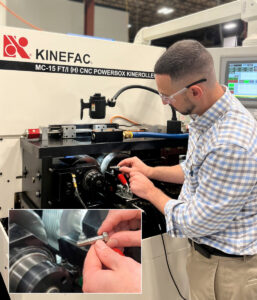 Kinefac research found significant performance improvements when threads were rolled rather than cut on as-printed Inconel 718 blanks.
Research results:
- 15% increase in yield strength
- 5% increase in tensile strength
- 7× increase in fatigue performance
Rolled threads in additively manufactured 17-4 PH stainless steel blanks also demonstrated significant improvements over cut threads. [See also Kinefac News, June 2, 2025, “Precision Thread Rolling Meets 3D Printing” presented by Dr. Willens at Aeromat 2025.]
Exploring Further Performance Improvements
Research is ongoing. Current efforts explore whether heat treatment of additively manufactured blanks prior to thread rolling can deliver additional performance gains. Our ultimate goal is to determine whether rolled threads in additively manufactured materials can provide the tensile strength and fatigue resistance required to meet aerospace and other demanding industrial performance standards.
New Possibilities for Aerospace and Industrial Applications
According to Dr. Greis, rolled threads on additively manufactured blanks support lightweighting goals and could enable specialized aerospace applications ranging from low-volume or obsolete-part replacement to mission-specific threaded components with geometries that are difficult or uneconomical to produce using conventional machining.
If you would like further details about this research, please contact DWillens@kinefac.com.